 EN
EN  DE
DE 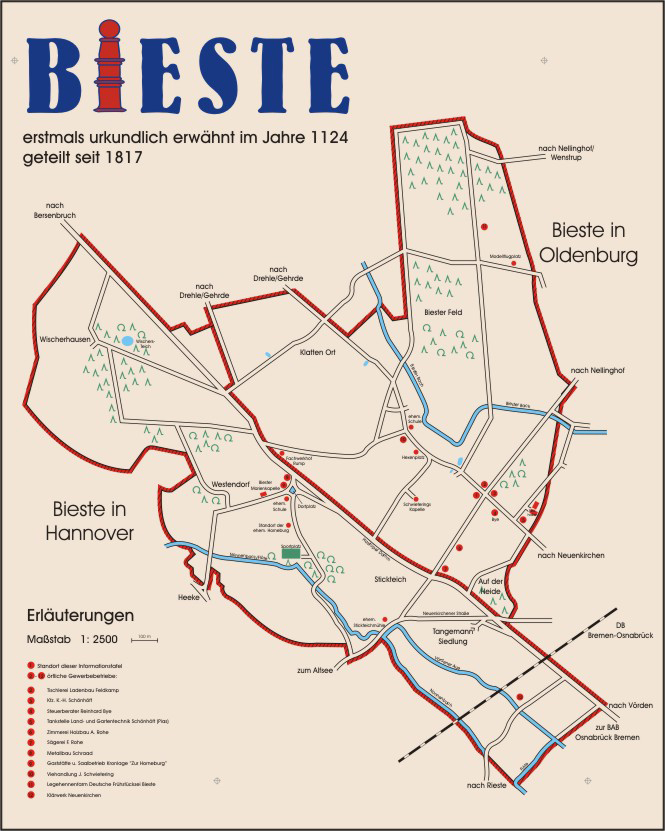
Bieste is a district of Rieste, Neuenkirchen-Vörden, Germany. Historically, Bieste is documented in the Osnabrück document book (Regesta-Imperii) for the first time in 1124 with the name "Biest".
The sovereignty over Bieste was disputed for centuries, but there was no border demarcation. Originally, the undivided farming community of Bieste belonged to the parish of Neuenkirchen and thus to the diocese of Osnabrueck. The secular rule was at times exercised side by side by the bishops in Osnabrück and Muenster.
With the abolition of the ecclesiastical principalities (secularization in 1802/1803, the people of Osnabrück became Hanoverians and the people of Münster became Oldenburgers. In 1817 the Duke of Oldenburg and the Elector of Hanover replaced the bishops in Osnabrück and Münster as sovereigns and finally agreed on a division of the farming community of Bieste.
The inhabitants were partly subjects of the Osnabrück bishop and partly subjects of the bishop of Münster. Ecclesiastically, Neuenkirchen and thus Bieste belonged to the bishopric of Osnabrück.
The secular division was followed, which was probably even more painful for the inhabitants at that time, by an ecclesiastical division. Bieste i.H. was separated from the old parish. The Catholic inhabitants were assigned to Lage and the Protestant inhabitants to Vörden. However, they remained assigned to the diocese of Osnabrück. In contrast, the remaining parish of Neuenkirchen lost its old Osnabrück connection. The Catholic parish of Neuenkirchen was incorporated into the diocese of Münster; the Protestant parish became part of the regional church of Oldenburg.
Today, Bieste i.H. (in Hanover) belongs to the municipality of Rieste in the district of Osnabrück, and Bieste i.O. (in Oldenburg) to the municipality of Neuenkirchen-Vörden in the district of Vechta.
The division has remained, but the old grown relations within the farming community have not been lost with it. In 1999 Bieste i.H. and Bieste i.O. celebrated a joint village anniversary. The occasion was a documentary mention from the year 1124.
Bieste is certainly much older. From urn finds it is clear that there must have been a settlement already about 2500 years ago. Further traces of the past can be gathered from the settlement forms. They lead to the Saxon period of the Middle Ages (600-800 AD).
The Freigericht and the Horneburg were of particular importance for the village. Through the Freigericht, several farms in Bieste were protected from the earlier customary bondage, which lasted until the 19th century. The Horneburg was an important aristocratic seat. It was founded in the 13th century by the von Horne family. A son of this family was Dietrich von Horne. He was the bishop of Osnabrück in the 14th century and played a significant role in the internal and external consolidation of the prince-bishopric. The old aristocratic seat disappeared in the 19th century. The buildings have completely disappeared. Remains of the old gateway can still be found in front of the chapel in Bieste i.H., which was built in 1926 and consecrated in 1927.
Bieste was and is a farming community that is strongly characterized by its location. Many families who still live in Bieste today have a history in Bieste that goes back over centuries and many family members have left Bieste, especially in the 19th and 20th centuries, towards America and other countries to build up a new beginning.
Source: 875 years of Bieste