EN
EN  DE
DE In old documents, wills, contracts you can find many terms, currencies, measures and weights that are no longer used. In the following, these are sorted thematically and of course also easy to find via the search function of the website.
To make it more easily understandable, the terms were left in German if there is no term in englisch and only the explanation was translated
Peasantry, Farmer and Farm classes
Farmer and peasantry (Bauer und Bauerschaft)
A farmer is someone who cultivates land to produce agricultural products. The peasantry consists of owners or tenants who independently manage a farm. Historically, a distinction was made between ownership classes and sizes of farms. The different classes do not necessarily reflect the economic situation of the farm.
Colon
Colon was originally the owner of a full hereditary farm. From about the 18th century every owner of a farm called himself Colon.
Full Heirs (Vollerben)
These farms belonged to the oldest settlement class and were usually established in the 12th century and earlier. The personal property of a farmer included the farmstead, the arable land and the meadows for hay use. Non-cultivated areas such as pastures, moor, heath and forest (Gemeine Mark) were common property, since parcelling was usually difficult or unprofitable. Accordingly, the Common Mark could be used by all peasants of the farming community, and the rights of use were clearly defined. The full heirs (Vollerben) had full rights to use the common land (Mark).
Half Heirs (Halberben)
A half heir was created by the division of a full heir. Over time, half heirs, quarter heirs, etc. were created. Their right of use was correspondingly lower. At the same time, the half-heirs naturally paid only half of the taxes and duties assessed on the heirs.
Kötter
A "Kötter" leased a house with land from a farm to farm it himself. He had no obligations to a farm. "Kötter" possessed only small rights to the Mark. Regionally, a distinction was made between Marktkötter and Erbkötter (Pferdekötter). The Erbkötter, in contrast to the Markkötter, were probably also called Pferdekötter (Horse Kötter)because only they could afford horses as draft animals. The Erbkötter were taxed approximately like a half heir and Markkötter still paid about 19% of the tax portion of a full heir.
Brinksitzer
The homestead of the Brinksitzer was usually no longer located in the village itself, but on the edge of a village and consisted of fields and pastures, which had been left to them by the old heirs or had been sold. The Brinksitzer did not own draught animals such as horses or oxen, and their arable land was usually so small that they often ran a trade in addition to agriculture, which was often reflected under the name (Schomaker - Shoemaker, Rademacher - Wheelmaker, Schnieder - Cutter, ...). A Brinksitzer was taxed like Kötter without horse and had no rights to use the Mark.
Heuerleute
Children who had no possibility to manage their own farm leased some land from a farmer and were also allowed to live on the farm (in barns, empty houses). A stable for a few animals was also provided. A verbal or written contract regulated the rent (Heuer) in the form of labor and cash. If Heuerleute lived in old, empty bakehouses they were also called Backhäusler or if they lived in empty Altenteilen they were called Leibzüchter. Many farmers also built simple houses especially for their Heuerleute. When in the 19th century the land (Mark) were divided among the peasants and in the context of the peasant liberation fiefs were converted into free property, against compensation, the decline of the "Heuerlingswesens" had come. Many of them emigrated to America or Holland or moved to cities to work as factory workers.
Neubauer
The (Neubauer, Brinklegger) is a farmer who has built up his own small farmstead. He is free, so neither dependent on a farm nor feudal lord, thus has no protection in emergencies.
Neighbor (Nachbar)
The farmers who have full rights in the village community are also called neighbors.
Mark
The Feldmark (Mark) is the area of all uncultivated land (arable land, meadows, pastures, woods, etc.) belonging to a Gemarkung (i.e. a municipality or estate). The name derives from the fact that the boundaries of the common land to the neighboring municipality, which in the village economic area were naturally located in the open field, were marked with so-called marks (hedge, trees, mounds, ditches, stones, ...). Therefore, the name Feldmark has been preserved in today's built-up areas as a designation of marginal sites located on the outer borders of the current or former municipal territory.
Plaggen
Are forest humus layers, which are removed from the surface with a spade. They are removed in the marrow and transported to the barn as a sub-layer. Interspersed with the feces of the animals, they are driven to the field as fertilizer.
Sterben und Erben
Kopfschatzregister
Is a tax register according to which taxes were determined based on the number of people on the farm who were over 12 years old. These taxes were determined for the first time in 1519.
Kirchspiel
A parish is a village (with church), which included as a rule several peasantries. The parish was the lowest level of the local land county administration.
Anerbe
Is a person to whom the undivided inheritance (the farm) is transferred. The other co-heirs are compensated. The right of an inheritance is the bequest of a farm to a single heir, so that it remains closed. It is a special succession to the farm. The farm is bequeathed to the "Anerbe" - separately from other property, which is bequeathed according to general rules - according to the special rules.
Sterbfall
is the movable estate of a serf, which after death falls to the lord of the manor.
Auffahrt
is an action when a foreign person comes to an owner's place. This usually means the money paid to the lord of the manor by the person who comes (e.g. marriage of a woman to the farm, for which the lord of the manor demands money).
Altenteil
Share of property that someone reserves when handing over his property (usually a farm) to the successor.
Leibzucht
is an "Altenteil", a house with is usually the sixth part of the land of the farm. If an "Altenteiler" died, half of it reverted to the farm. Only the personal belongings were allowed to be used by the "Altenteiler".
Government form, rights and duties
Country rulership (Landesherrschaft)
is the medieval form of state power in a given territory. It originated in the 12th century and was fully developed in the 13th and 14th centuries. All rights are in one hand, that of the sovereign. The goal is the domination of territory and area.
Manorial rule (Gutsherrschaft)
is the name for a form of rulership that developed since the Middle Ages with the eastern colonization in the eastern territories of the Holy Roman Empire. It originated from the landlordship. The landlord not only had extensive property of 100 hectares or more (manor district), on which predominantly grain was cultivated and often also craft production with local monopoly was exercised (brewing rights, compulsory milling, brick and lime burning monopolies), but also held a dominant position as mediator of the sovereign authority in the agrarian society by means of hereditary servitude as well as transferred criminal and police power (patrimonial jurisdiction). It was not until the beginning of the 20th century that this mode of operation gradually ceased to exist.
Landlordism (Grundherrschaft)
Landlordism refers to the power of the lords over the peasants on the basis of the disposition of the land. From the Middle Ages until 1848 and the liberation of the peasants, it was the predominant legal, economic and social ownership structure of rural areas.
Hochstift
is the central administration of the diocese and consists of the bishop, the diocesan curia and the cathedral chapter.
Dioceous (Diozöse)
District of a ruling bishop in which he exercises spiritual authority.
Feudal System (Lehnswesen)
The feudal system was a system of rule and ownership developed in medieval Europe. It was based on the comprehensive hereditary right of use that a feudal lord conferred on his liegemen over a thing belonging to him, the fief or feudal estate (e.g. a farm), as well as on a reciprocal vow of loyalty.
Feudal Lord (Lehnherr)
In the feudal system, he had the supervision over one or more feudal men to whom he gave land or an office as a fief and received absolute loyalty, obedience and service (e.g. service in arms) in return. He obliged to maintenance and protection (eg in court or in case of attack).
Meier
Many farm owners, voluntarily or involuntarily, handed over the farm to the church or a nobleman after 800. They thereby acquired greater protection from the lord of the manor and were freed from the burdensome military service. The farm was then returned to them in exchange for certain annual dues and service. Around 1400, about half of the 3000 farms in the country belonged to the church, the others to the nobles and neighboring lords. At the time of Bishop Dietrich of Horne (1376-1402) all the free ones had to have a patron. The bishops had these farms administered by Schulze or Meier (Meierhöfe). The administrator of several Meierhöfe was the Redemeier.
Eigenbehörigkeit
is a special form of serfdom in northern Germany. The peasant remains the owner of the farm, but may not make any significant operational or personal decisions on his own farm without the consent of the landlord. He is obliged to pay dues to the landlord (uncertain and certain slopes) and receives protection from the landlord in return (e.g. in case of defense).
Gefälle
Services to the landlord
Gewisse Gefälle
are regularly recurring fees such as rent, manual labor, and wages. The farmer was prepared when the payments or duties in goods had to be settled. Not so with the " Ungewissen Gefällen " (uncertain fees).
Spannleistung, Fronleistung
Depending on whether they were obliged to provide services with horses or without them, a distinction was made between the "Spannbauern" and "Handbauern".
Paying off (Ablösung)
is the abolition of dues and service obligations to the landlord between 1800 and 1870. Peasants usually paid a one-time amount to then be free from further payment and obligations to the landlord in the future.
Education and profession
Präparandie
A preparatory school (or Präparandenschule), sometimes also called a Präparandie, was the lower level of elementary school teacher training from the 18th to the early 20th century. It prepared students for attendance at teacher training colleges, hence the name Präparand (Latin for someone who had to be prepared) for the students of this institution. Training began immediately after the end of elementary or secondary school.
Currency and coins
Until the 16th century, the Mark, Schilling (Sch.) and Pfennig (pf.) were used. The Mark and Schilling were only units of calculation, minted were only pennies, half pennies and quarter pennies.
From 1554 until the 19th century in the Principality of Osnabrück was calculated with Reichstalern. The Reichstaler (Rthlr., Rthl., rthl., Thl.) was a real, large coin initially created in the 16th century with a value of 24 ( Reichs-) Groschen, 36 Lübische Schillingen or 68-72 Kreuzern. It was also called the Prussian thaler. In the Lower Chapter of Münster, it was also reckoned in Guten Groschen and Groten.
From 1825, in the Kingdom of Hanover, the bill was introduced with talers (Tl.), Mariengroschen (mgr.) and Gutegroschen (ggr.).
In 1859, the Neugroschen (ngr.) was introduced for the Kingdom of Hanover.
In 1873, the Mark (M) and Pfennig (Pf) were introduced in the German Empire.
In 1923, after inflation, Rentenmark (RM) and Pfennich (Pfch) were used.
In 1948, after the currency reform in the Federal Republic of Germany (FRG), the Deutsche Mark (DM) and Pfennig (Pfg) were introduced.
In 2002, the Euro was introduced almost throughout Europe.
| Year | Region | Mark | Taler | rthl. | M | Sch. | pf. | ggr. | mgr. | Groten | ngr. | Groschen | Pf | RM | Pfch | DM | Pfg | Euro | Cent |
| until 1600 | 1 | 12 | 144 | ||||||||||||||||
| 1554-1900 | Prince Bishopric Osnabrück | 1 | 21 | 252 | |||||||||||||||
| Münster Lower Abbey | 1 | 24 | 72 | ||||||||||||||||
| since 1825 | Kingdom of Hanover | 1 | 288 | 24 | 36 | ||||||||||||||
| 1859 | Kingdom of Hanover | 1 | 300 | 30 | |||||||||||||||
| 1873 | German Empire | 1 | 3 | 10 | 100 | ||||||||||||||
| 1923 | German Empire | 10 | 1 | 100 | |||||||||||||||
| 1948 | FRG | 10 | 1 | 100 | |||||||||||||||
| 2002 | Almost all Europe | 1,956 | 1 | 100 |
Maße
Area Measurements
The area measurements in the Principality of Osnabrück were not uniformly regulated. A distinction was made between Osnabrück, Dammer, Ankumer, Menslager and Quakenbrück measurements. In the parish of Neuenkirchen, the Dammer measure was used. The following data are only approximate:
Scheffel Saat: Arable land for which 1 bushel of seed grains is needed.
Quadratrute: Based on the length measure of the rod and was used in several countries. In the German states, the square rod varied between about 7.13 and 36.25 m².
Morgen: A "Morgen(Mg)" was an area measure of about 2500 to 3500 m² used in Germany until about 1900. Originally, it was the area that could be plowed in one morning with a single-furrow horse or ox plow. Often the acre was defined as a rectangle with sides of an even number of local rods, since turning was to be avoided as much as possible when plowing. Predominantly, an acre was between 120 and 160 square routes.
Acres: Originally, an acre (ac) was defined as an area of arable land that an ox could plow in a day. The unit varied between 19 and 65 acres. Since 1995, an acre has been defined as 4,046.8564224 m².
Hectare: The word hectare (ha) is borrowed from French, is based on Greek hekatón 'hundred' and thus means hecto-ar = 100 ar. In 1879, the hectare was included by the CIPM (Comité International des Poids et Mesures) in its recommendations. Even before that, the hectare had been part of the North German Confederation's Weights and Measures Code of 1868, which came into force throughout Germany on January 1, 1872. Since the late 19th century, one hectare in the German Empire was exactly equal to four acres, which was therefore also called Viertelhektar (vha) to distinguish it from traditional measures.
| Measure | Dimension | since 1995 |
| m² | 10.000 | 10.000 |
| Hectar | 1 | |
| Ar | 100 | |
| Quadratroute | ca. 200 | |
| Morgen | 4 | |
| Acre | 1,5 - 5,3 | 2,471 |
| Scheffel Saat | ca. 8,3 | |
| Malter Saat | ca. 0,7 |
Script
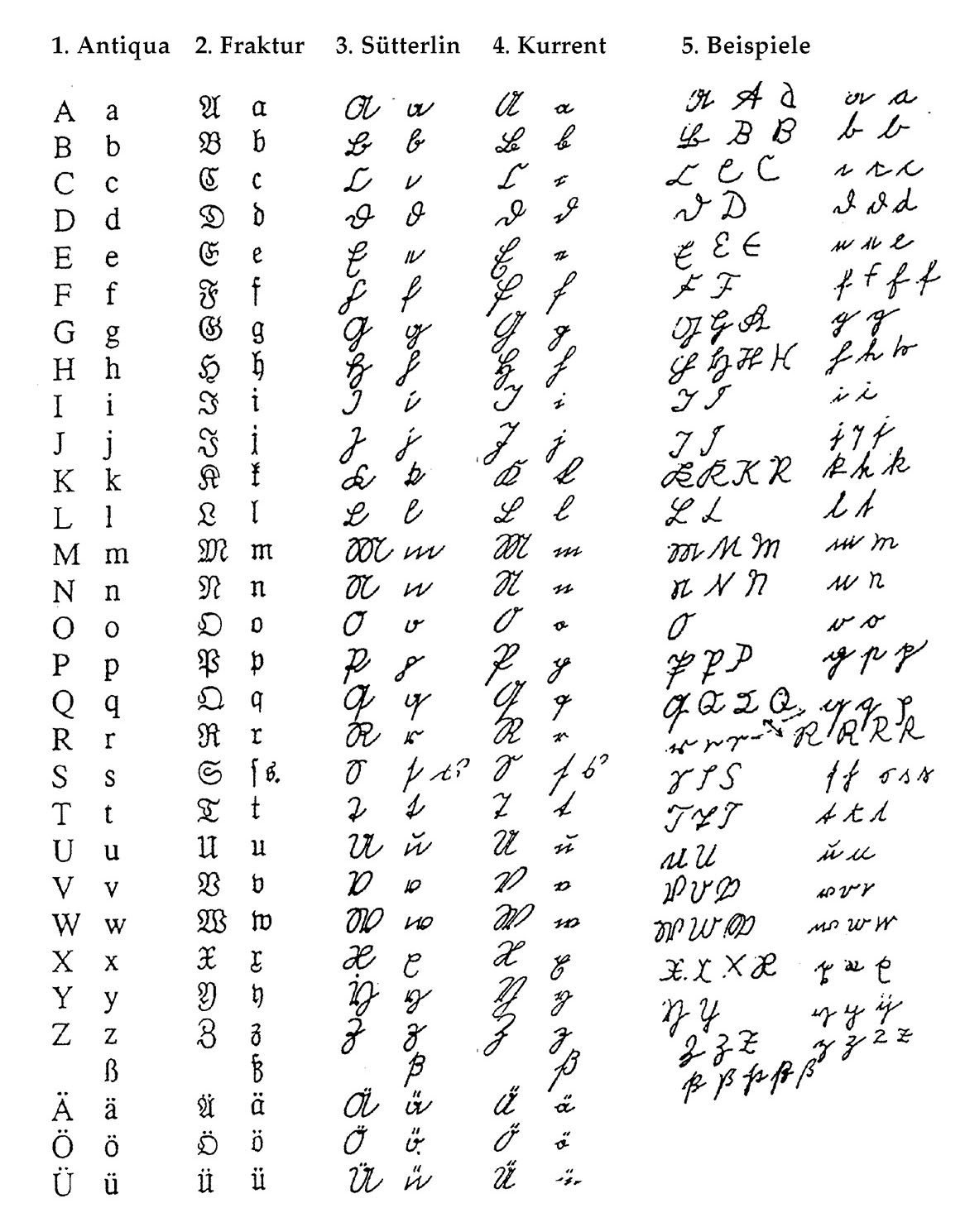
German script (Deutsche Schrift)
The German script developed from the Carolingian minuscules (typeface developed in the French monastery of Corbie in the 8th century) between the 12th and 13th centuries. It was adapted to the German language and continued to develop until the beginning of the 20th century.
Antiqua
Antiqua refers to typefaces for the Latin alphabet that are based on a 15th-century Italian Renaissance humanist script. Fraktur is a typeface from the group of Latin fonts and was the most widely used typeface in German-speaking countries from the mid-16th century to the beginning of the 20th century.
Fraktur
Fraktur is a typeface from the group of Latin fonts and was the most widely used typeface in German-speaking countries from the mid-16th century to the beginning of the 20th century.
Süterlin
The Sütterlinschrift refers to a reformed spelling of the German Kurrent, which was developed in 1911 by the graphic artist and pedagogue Ludwig Sütterlin on behalf of the Prussian Ministry of Culture and became established in the 1920s as a starting script for schools.
Kurrent
The German Kurrent script is a briskly written script, a so-called running script (lat.: currere = to run). It was taught in schools for over 100 years. In the 19th and early 20th century it was the common script in Germany. The so-called Sütterlinschrift refers to a reformed spelling of the German Kurrent, which was developed in 1911 by the graphic designer and educator Ludwig Sütterlin on behalf of the Prussian Ministry of Culture and became established in the 1920s as a school output font.